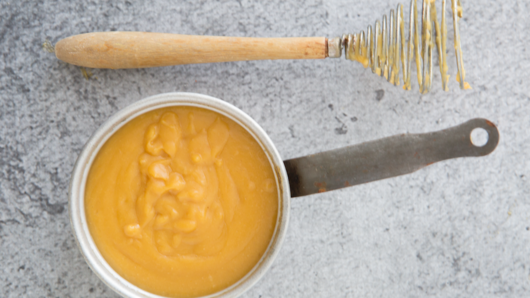
Serve this flavorful sauce with steamed vegetables and brown rice for a quick and tasty meal. There are so many flavors of miso on the market, but for this recipe we recommend a white miso, since this is lighter in flavor and will not overpower other flavors in the dish.
Steps
1
Making the Sauce
Ingredients
1/3 cup kombu stock
1/4 cup plus 2 tbsp mellow white miso
3 tbsp mirin
3 tbsp sake
In medium saucepan, bring the kombu stock to a simmer and add the miso, mirin and sake. Remove from heat and and whisk the mixture until smooth and creamy.
Serve as a great sauce as a glaze, or as a sauce on top of your favorite vegetables and brown rice.
57 Comments
Marcia S•
What is kombu stock? A better question is what is Kombu itself.
Kombu is kelp used in the Japanese kitchen. Kombu stock is kelp simmered in water to create a flavorful base liquid for many applications. Alternatively, you can soak the kelp in cold water, in the refrigerator, over night.
Hi Elisha and thanks for your question. So generally speaking, substituting vegetable stock for kombu stock is acceptable. However, if you are specifically preparing a Japanese dish, then no, not really...the vegetable stock may skew the flavor profile. All that said, if you are limited to only vegetable stock, it can serve as an acceptable alternative. All the best and thanks for learning with Rouxbe! Chef Kirk
Can you use any seaweed or is Kombu something special you buy at a certain market? What about Ottogi Sea Tangle? For some reason we happen to have some of that alongside some sushi nori already in the cupboard. :-). --A
Hi Elissa -
Thanks for your question. Yes indeed, I have purchased kombu at Whole Foods Market and it's also available at King Soopers (Kroeger) as well as Amazon. Thanks again for learning with Rouxbe! Chef Kirk
Hi Vanessa -
Great question. I sometimes use Chinese rice wine or dry sherry instead of sake - please let me know what you think! All the best, Chef Kirk
Mirin is a common seasoning ingredient used in the Japanese kitchen. It basically consists of sake with the addition of sugar. Since there is already sake in this recipe, you might substitute some sugar to achieve balance on the palate. I don't necessarily recommend adding more sake as the sake flavor may become too strong.
Use an approximately 4" x 4" (some sources say 'postcard size') piece of dry kombu. Simmer in about 1 to 1.5 quarts of water for 5-10 minutes. The amount of water and time can vary based on how much you need and how strong you want the stock. Alternatively, soak the kombu in cold water, in the fridge, overnight. This method produces a slightly 'cleaner' flavor because the kombu will not have been subjected to heat. The kombu dashi (stock) can be stored in the fridge for five days or so.
Hi Ellen,
Thank you for your question. For this particular sauce, you could try rice wine vinegar plus a little sweetener if that ingredient is acceptable for you. You could also try adding citrus in place of both mirin and sake. I might recommend trying a different miso sauce altogether as there are many variations that are alcohol free and delicious. I love combining miso, tahini, garlic, ginger, lemon and water in a blender. Below is a link to a miso sauce recipe that we have here at Rouxbe. Happy cooking!
https://rouxbe.com/recipes/5149-citrus-miso-dressing
HI Terri, thanks for your question. You can use the cooking sherry here if you want to use what you have on hand. I would encourage you, if you use alcohol in your cooking, to avoid 'cooking' wines moving forward. They contain added salt to preserve them but also so that they can be sold in grocery stores rather than the alcohol section/ liquor store. They are much lower quality and they tend to negatively impact flavor, in my opinion. I love to cook with wine and alcohol that I would drink. You can get a bottle of dry sherry that can last quite a long time. But to answer your question, yes, sherry is a fine substitute here. Happy cooking. Lauren
Hi! Can I use kelp powder as a substitute for the kombu? If yes, how would I incorporate it? What would be a good ratio of kelp powder to water? Thank you.
Maria, yes, you could use kelp powder to make kelp stock. You'll need to do some experimenting to find the flavor intensity you want. It is quite suitable to vary the flavor intensity based on the application. Begin with 1 tsp of kelp powder to 1 quart of water, then adjust as desired. Simply add the powder to the liquid. It is up to your personal preference as to whether you might strain out any pieces of kelp before using the stock.
Hi Simone!
If you have a natural health food store near you it will likely have miso, kombu and mirin. Miso is a fermented, salty paste made from beans or grains and koji. It adds a salty, earthy quality to food. Kombu is a dried sea vegetable and mirin is a sweet, Japanese rice wine that can usually be found near tamari or soy sauce in many stores. You can find Sake in in most liquor stores depending on where you live. Best of luck, Lauren
HI Lisa. That is a complex question. The flavor profile of a food or dish is both technical and subjective. Our tongues house taste buds for certain flavors. So the first bite of a watermelon might be sweet but well chewed brown rice is also sweet. The next time you eat something, chew it for a while and assess what primary tastes you detect from sweet, sour, pungent (spicy), salty and bitter (coffee. beer, dark greens, roots). You will start to discern flavors. Interestingly, each flavor is balanced by another one when creating a dish. If a food is too salty, you can add sour ( a squeeze of lemon) or if it is too sweet you can add pungent ( cracked pepper). Flavor is complex but the key to understanding it is paying attention to what you are tasting. There is an awesome book called "The Flavor Bible" that you can look at as well as this article. https://cooking.marcgottlieb.com/2014/11/flavor-profile/ Lauren
David, for general cookery, look for a dry or mostly dry sake. If the application is specifically sweet, for example, then a sweeter style may be in order. As for brand and price point, it's up to the consumer and their sake budget. As a reference, many restaurants use less expensive products like Shochikubai, which provide the sake flavor while any perceived "roughness" is covered up by the other ingredients.
Hi Susan. Yes! Chickpea miso is soy free and super delicious. Here is a link to one brand that I like: https://great-eastern-sun.com/shop/miso-master-miso/miso-master-organic-chickpea-miso/miso-master-chickpea-miso/
Lauren
Hi Ivonne, kombu stock is pretty thin. Look for light aroma and flavor. If the kombu is allowed to sit overnight in the water, then you may see some slight thickening the next day. But, this is not a required step nor characteristic when making kombu dashi.
I've just checked my cabinet and I thought I had kombu, but it turns out I only have dried Arame, dried Wakame and the Dulse flakes. Can any of these be used in place of kombu and if so, which is preferred please?
Hi Tina. I love that you are stocked with sea vegetables. Absolutely. Any of those would work. I would choose arame here. Simmer it in water and then strain it to achieve the stock and then proceed with the recipe. Your an go lightly with the arame unless you are a big fan of that oceanic taste. Lauren
I don't drink alcohol or use it in recipes. Is there an alcohol free version of this recipe? Stock, miso, ume plum or rice vinegar? Thanks for your help!
I don't drink alcohol or use it in recipes. Is there an alcohol free version of this recipe? Stock, miso, ume plum or rice vinegar? Thanks for your help!
Hello, Susannah: I do not use alcohol. I enjoy using a homemade vegetable stock, or lemon juice. With this recipe, white rice vinegar would work. Lemon juice is my go-to. Cheers, Char
The citrus miso dressing link goes to a recipe with oil. Would you have a different recommendation for alcoholic free, oil free dressing replacement for the easy miso sauce?
Hello, Christine: I also cook without alcohol, and instead of the sake, I use "unseasoned" rice vinegar. It works perfectly. I also cook without oil, and will add chia seeds or ground flax meal to the dressing, mix well, and allow to thicken in the fridge for a few hours. A teaspoon of flax meal works well. If you are looking for a citrus flavor, freshly squeezed orange, lime or lemon juice would work well. If you are looking for quantities, an ounce of orange juice, or the juice of one freshly squeezed lemon or lime. Hope this is helpful to you. Thanks, Char
Hi Luz,
Great question! Kombu and Nori are not the same. Kombu is a much more hearty sea vegetable that can be re-hydrated and soaked/steeped to make a flavorful liquid, while nori sheets are a sea algae that is processed into sheets for wrapping sushi. The nori would discinigrate in the steeping process and have a much different flavor profile. I hope this helps!
Cheers,
Sandy
Hi Jessica, There is nothing spicy, per se, in this recipe, though with the mirin and sake, there is alcohol and will let you be the judge if the heat of alcohol affects your system. Cheers, Sandy
I purchased the Kombu Dashi Powder on Amazon.com. I mixed it with water as directed but it made me feel light headed. I made the sauce with the soup and continued to feel out of the norm. I didn’t practice roasting my squash with it. Has anyone experienced that?
Julieta, as with most leftover foods in the refrigerator, try to use it within about a week. And, you can freeze it, too. Expect some separation upon thawing, in which case you can whisk the mixture to incorporate it.
Can I use a different type seaweed for this recipe? There’s an Asian market nearby where I’ve purchased a variety of other seaweeds used when flavoring Asian dishes. I can’t find this.
Hi Sherell, for this sauce, the miso paste is purchased, then the sauce is made at home. If you prefer to purchase a ready-made miso sauce, you are welcome to do so. However, we suggest making the miso sauce so you can avoid additives commonly found in ready-made store-bought foods. ~Eric
My sauce is very watery despite following the directions. Also simmering the kombu for 10 mins did not add much in terms of flavoring the stock. Any thoughts?
Hi Karen, this is a relatively thin dressing. However, you can try to reduce the kombu stock, which is the watery ingredient, but you'll need to maintain the overall flavor balance. Also, if the kombu stock is light on flavor, then simmer the kombu longer to impart more flavor. Enjoy! Eric


 Eric W • Rouxbe Staff •Kombu is kelp used in the Japanese kitchen. Kombu stock is kelp simmered in water to create a flavorful base liquid for many applications. Alternatively, you can soak the kelp in cold water, in the refrigerator, over night.
 Kirk B •Hi Elisha and thanks for your question. So generally speaking, substituting vegetable stock for kombu stock is acceptable. However, if you are specifically preparing a Japanese dish, then no, not really...the vegetable stock may skew the flavor profile. All that said, if you are limited to only vegetable stock, it can serve as an acceptable alternative. All the best and thanks for learning with Rouxbe! Chef Kirk
 Amy A •Can you use any seaweed or is Kombu something special you buy at a certain market? What about Ottogi Sea Tangle? For some reason we happen to have some of that alongside some sushi nori already in the cupboard. :-). --A


 Kelly C •Can dashi be frozen? I like to freeze extras in ice cube trays as I always have extras.
 Lauren L •Hi Ellen, Thank you for your question. For this particular sauce, you could try rice wine vinegar plus a little sweetener if that ingredient is acceptable for you. You could also try adding citrus in place of both mirin and sake. I might recommend trying a different miso sauce altogether as there are many variations that are alcohol free and delicious. I love combining miso, tahini, garlic, ginger, lemon and water in a blender. Below is a link to a miso sauce recipe that we have here at Rouxbe. Happy cooking! https://rouxbe.com/recipes/5149-citrus-miso-dressing
 Terri A •Hello. Kirk B said he sometimes uses dry sherry instead of sake. I have cooking sherry. Would that work?
 Maria N •Hi! Can I use kelp powder as a substitute for the kombu? If yes, how would I incorporate it? What would be a good ratio of kelp powder to water? Thank you.
 Simone M •Hello, I am not sure if these ingredients are at my disposal. Also what is mirin? Thank you
 Lisa K •So is this thing called a flavor profile a technical thing or a personal thing that develops over time
 Tina K •I've just checked my cabinet and I thought I had kombu, but it turns out I only have dried Arame, dried Wakame and the Dulse flakes. Can any of these be used in place of kombu and if so, which is preferred please?
 Sophie S •Is Mirin very sweet? I'm finding a lot of these recipes very creamy and rich and also very sweet.
 Susannah J •I don't drink alcohol or use it in recipes. Is there an alcohol free version of this recipe? Stock, miso, ume plum or rice vinegar? Thanks for your help!
 Char N • Rouxbe Staff •Hello, Susannah: I do not use alcohol. I enjoy using a homemade vegetable stock, or lemon juice. With this recipe, white rice vinegar would work. Lemon juice is my go-to. Cheers, Char
 Christine J •The citrus miso dressing link goes to a recipe with oil. Would you have a different recommendation for alcoholic free, oil free dressing replacement for the easy miso sauce?
 Sandy S •Hi Luz, Great question! Kombu and Nori are not the same. Kombu is a much more hearty sea vegetable that can be re-hydrated and soaked/steeped to make a flavorful liquid, while nori sheets are a sea algae that is processed into sheets for wrapping sushi. The nori would discinigrate in the steeping process and have a much different flavor profile. I hope this helps! Cheers, Sandy
 Linda J •I purchased the Kombu Dashi Powder on Amazon.com. I mixed it with water as directed but it made me feel light headed. I made the sauce with the soup and continued to feel out of the norm. I didn’t practice roasting my squash with it. Has anyone experienced that?
 Elizabeth J •4 stores later...QFC...Kroeger...Safeway...and finally an Asian market...and the Kombu search is finally accomplished!
 Kathryn C •Can I use a different type seaweed for this recipe? There’s an Asian market nearby where I’ve purchased a variety of other seaweeds used when flavoring Asian dishes. I can’t find this.
 Sherell S •Can I just use a miso I purchased at a health food store rather than making this miso?
 Karen K •My sauce is very watery despite following the directions. Also simmering the kombu for 10 mins did not add much in terms of flavoring the stock. Any thoughts?
 Debbie M •Just want to say thank you all for this dialogue! I had questions about this recipe, but not anymore :) Excited to make it!