You will not miss the egg or versatility of traditional pasta in this fresh dough. This is a simple and delicate base to work with for rolling and shaping a variety of fresh pasta dishes.
Chef's notes
This basic dough can be enhanced by adding several flavor combinations:
Yellow: add turmeric and yellow pepper powder
Red: add red bell pepper powder
Green: add spinach and leek powder
Steps
1
Preparing the Pasta Dough
Ingredients
1 pack (8 to10 oz) silken tofu
1 tbsp olive oil
1/4 tsp turmeric
1/4 tsp sea salt
1 1/4 cup 00 flour, or all–purpose flour
1 1/4 cup semolina
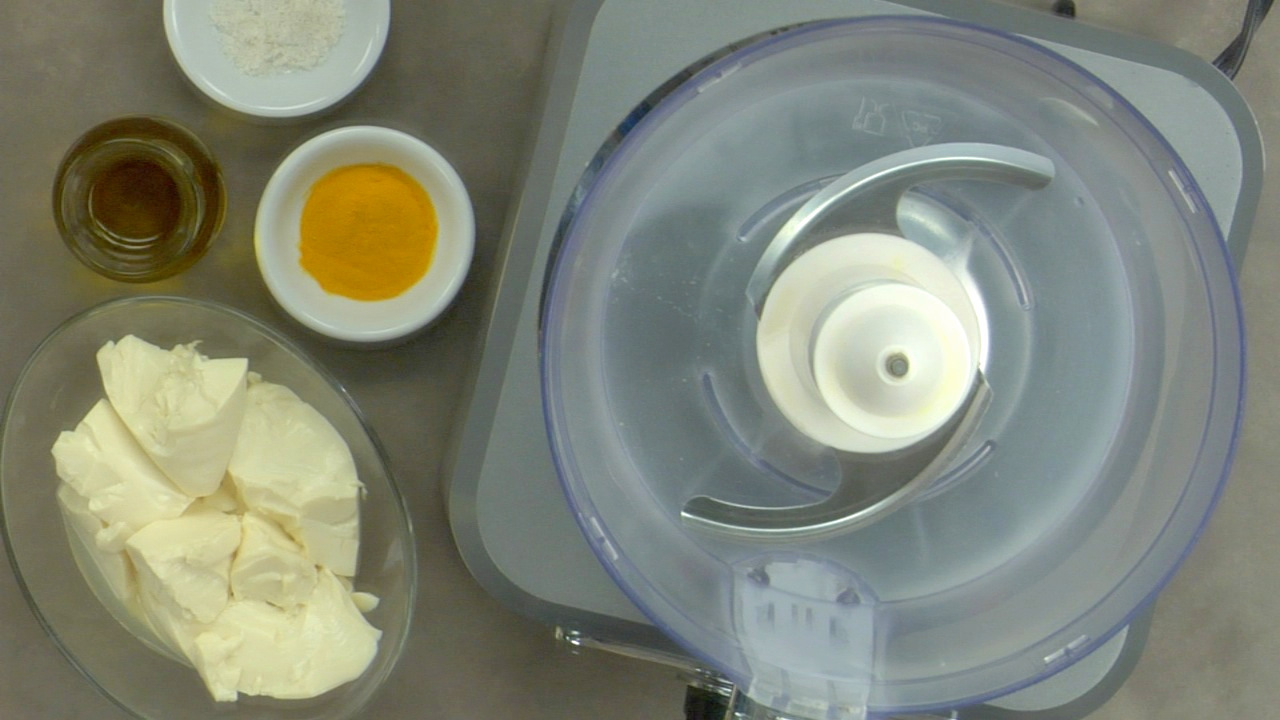
First gather and prepare your mise en place.
To prepare the dough, in a food processor, blend the tofu, oil, turmeric and sea salt until smooth. Add the flour and semolina slowly, in equal parts, until the dough begins to clump into a ball. Use a slower speed or pulse setting to combine the ingredients together.
Remove from the food processor and place on lightly dusted board.
Knead the dough for about 10 minutes until very smooth. Add more flour and semolina slowly until the dough is not sticking to the countertop. Wrap tight in plastic wrap and allow the dough to rest for at least 30 minutes, or overnight in refrigerator.
Once rested, roll out the dough and use in multiple applications. * If the dough has rested overnight in the refrigerator, to make it more pliable, bring it out and let stand at room temperature for approximately 30 minutes before rolling.
82 Comments
Bonnie D•
Can you freeze this dough? I had so much after making this recipe. I divided it into smaller portions, wrapped in plastic and put in a freezer bag and will give it a try. This was a fun exercise. When I made the manicotti with my pasta machine I rolled it out too thin for this first round. Next time I will make it a bit thicker for making ravioli and manicotti.
Yes, this dough will freeze well. Once defrosted you can continue to roll it out and cut to desired size/shape. When I have left over dough I will always freeze for a later date. Also I will make piles of fresh pasta and freeze on a sheet pan. Once frozen I place them in zip locks and add to boiling water for a quick meal.
Glad you enjoyed this recipe.
Cheers,
Chad
The pasta was great. I was hesitant to use tofu but was surprised it was delicious. I was disappointed on the color of the pasta. I thought the purpose of adding turmeric was for the color. I added double turmeric and color did not change. Please try it you will like it. Thanks for great recipe.
The picture for this recipe shows a few different varieties of colored/flavored pasta dough. Using the turmeric will not color the pasta too much and will only give it a more natural more traditional egg pasta look.
As covered in the pasta lesson:
To make flavored and colored pastas, add dried vegetable powders and spices. For example:
Red pasta: Add vegetables powders (for example, sun-dried tomato, red or chioga beet, or red pepper) or paprika.
Yellow pasta: Add golden beet powder, yellow pepper powder or turmeric.
Green pasta: Add spinach, kale or leek powder, or dried herbs.
Endless possibilities.
Cheers,
Chad
Hi . This is first time I see tofu in fresh pasta dough? What is its purpose in the dough? What type of flavor does the turmeric gives this dough?
I am excited to give this a try. Ciao!
In this recipe, the tofu adds fat and protein to help mimic the binding function that egg would ordinarily have in laminated pastas. The turmeric is just to add a hint of yellow - to resemble egg as well - it does not really impart any (or much) flavor at all. ~Ken
To mimic the tofu, there is no great substitute. It adds both protein and fat, as well as supporting the overall smooth dough texture.
I might suggest a regular dough - just water, flour and a touch of oil.
~Ken
Hi Dawn- Sure, you can... try one of the "1 to 1" type flours designed to be used in pancakes and other more delicate foods. Some flour blends are denser/heavier than others (e.g. made with a lot garbanzo bean flour) so a lighter flour (more rice flour in the mix, perhaps starch) may work best in this case. ~Ken
How is the best way to store fresh homemade pasta if I am not going to serve it for 4-5 hours? This recipe is great. Thank you in advance for your assistance.
Hi Kathleen - The best way to store raw fresh pasta is in small bundles, lightly dusted with flour. These bundles/nests can be on a sheet pan that is loosely wrapped as to not let the pasta dry out too much. Good luck! ~Ken
Does it matter if the food processor doesn't create a ball? I was able to still make the dough but wondering if I should try to achieve the ball for next time with a different approach.
What food processor do you recommend for kneading dough. I'm in the market for a new food processor for my home kitchen and I'm getting mixed reviews on line. I will appreciate your thoughts. Thank!
Hi Cindy - I hope you are well. Thanks for your question - a big investment for sure! I am a big fan of Robot Coupe - which may be too expensive as it's used in many professional kitchens - here's a link to take a peek http://www.robot-coupe.com/en-usa/. There are several videos that demonstrate what this machine can do. If too expensive, great to compare against other brands. I hope this helps! Chef Kirk
Thinking of using this dough to do an extruded pasta like spaghetti or rigatoni. I’ve done this dough for laminated pasta but unsure if it will stand up to the pressure of extrusion. Of course, the best thing about cooking is to “just try” (which I might), but was hoping someone had already tried and was interested in hearing the results. If the dough is too delicate(?) for extrusion could more semolina pasta maybe make it more likely to work? Thx
Hi Randy - great post and thanks for the inquiry. Indeed, your instincts are right on here - the extrusion process definitely puts a little pressure on - I've enhanced the stability of this type of recipe with a dusting of semolina flour in the past and it worked very well! Think about starting with smaller batches to control the product more. I look forward to your results! All the best Randy, Chef Kirk
Hi Susie and thanks for your question. Indeed, you can proceed to cutting or shaping this dough into any pasta shapes you prefer. As for cooking, I've had good luck in cooking dairy-free pasta approximately 2 minute less/shorter than pasta that includes dairy. So for me, I've historically cooked pasta with dairy to the al dente stage - which takes 8 - 12 minutes. I live in Boulder, Colorado - so at high altitude, water boils at 205 degrees vs. 212 so my water takes a bit longer to get a nice roll and because the temperature is lower, it may take longer to cook than at sea level, etc. So depending on where you live Susie, use the 8 - 12 min window and for the dairy-free pasta, think about shaving a couple minutes off that time. Also, once cooked and drained, I would recommend not letting the pasta sit in the colander for too long as it might get sticky. Perhaps add back to whatever sauce you've decided on as soon as possible. I hope this helps Susie. Thanks for learning with Rouxbe. All the best, Chef Kirk
Hi there Dawn and thanks for your question. I've made this recipe using this exact scenario and it worked out just fine. I do recall adding a touch more olive oil but for the most part, you can use the whole package. Thanks for cooking with Rouxbe! Chef Kirk
As you all mentioned in a previous question it is best to store this pasta in small bundles which are lightly dusted with flour if there is some time between preparation and cooking/serving. During this storage time, should the bundles of pasta be left at room temperature or in the fridge?
If the bundles of pasta will be used relatively soon (e.g. the upcoming meal), then they can be left at room temperature. Otherwise, with food safety in mind, it is often best to refrigerate the dough. The noodle can be dried as soon as they are cut.
Hi. I am a home seller of homemade egg less pasta. Which is the best pasta maker and dryer that I can purchase? Secondly, till I purchase the pasta dryer what is the best way to dry the pasta and for how long? Thirdly, will the stuffing in stuffed pasta not make the pasta soggy till I sell it the following day. Thank you in advance.
Good afternoon Rinku,
I hope that I can answer some of your questions here. As far as the pasta maker is concerned. I prefer a manual pasta maker, Marcato Atlas. This machine has the ability to work as a manual or automatic. There are various attachments that are available for these units and I believe the price starts around $70-80. There are of course units that sit above and below this price range. As far as the drying rack is concerned, I currently use a wooden dowl rack that looks similar to clothes drying rack. I know that there are high-end professional drying racks that may run a few thousand dollars although for home use it is important to watch air flow, humidity, room temperature and time. You do not want to retain moisture during this process. Our pasta is dried for 24 hours before we are able to store for future use. I am not sure what your filling is or how it might affect the integrity of the pasta as far as stuffing the pasta. Most likely a stiffer stuffing may produce a product that may hold up better than others. Sometimes in your local community or through the food service, there are non-profits or other food institutions that test food for shelf life and packing concerns. I would consider using some local resources for this stage depending on your local food safety laws. I hope this information helps
Thank you Brian. Your response was very helpful. I tried to home dry my pasta but it turned dark and by morning it got soggy again. I use fine semoolina and all purpose flour(2:3),oil,salt and water for the dough and spinach and ricotta/feta for the stuffing. But i agree my spinach and ricotta suffing contained some moisture and the dough was quite soft. I ll be careful in maintaining the stiffness of the dough and stuffing next time. Besides air trying, is there machinery available for a quick and guaranteed pasta drying?
Good day Rinku,
You might want to look into something a bit more industrial for your purposes. I have been around a few larger scale pasta dryers and thought you might find what you are looking for in a piece of equipment closer to the "La Monferrina" pasta-dryer found at Pastabiz or "La Monfererrina" website. You are really looking to control the environment/humidity. Please let me know how things go
Hi Lisa,
Whole wheat pastry flour (wwpf) contains slightly less gluten and less protein so it is a softer flour. I prefer working with WWPF to achieve a silkier dough. Most often I use 50% all purpose and 50% wwpf. You can play with the ratios to achieve the dough that you like best but ultimately any combo will work. One more tip: I have found a 100% whole wheat flour called "Golden Buffalo" that produces an amazing texture similar to AP flour. You can find it online.
Keep us posted on your discoveries!
Lauren
HI Jody. Thank you for your question. Tofu adds protein and fat which mimics traditional egg pasta in texture. You could likely just add a small amount of olive oil and have a fine outcome. I would start with a small batch and see how you like the result. Best of luck. Lauren
Lauren L - Decided to try the recipe "as is" before I tried it with Whole Wheat. It was great! My husband said he doesn't really like pasta so more for me. LOL Now I'm going to look for 'Golden Buffalo' and do it again. Thanks for a great recipe
I live in Namibia. Tofu is not easy to come by locally. I eventually got hold of two blocks. There was also no semolina so I bought couscous and ground it fine. My processor only makes a small ball. I kneaded it for at least 15 minutes and although it came together a little more it’s very dry and crumbles easily. I really doubt it will work after resting ? Any advice would be appreciated.
Jacqueline, The issue with couscous in this situation is that it has already been heat treated (steamed, for example), so it will not act the same way as raw flour. If you don't find semolina flour, you could try grinding wheat berries, or try any other relatively high gluten flour, such as "bread" flour.
Jacquie, you could eliminate the 1 Tbsp of added oil, but it will lack just a bit of pliability. You can adjust the moisture content, as needed, to achieve a smooth dough.
Hi Valentina! Great question. I have not tried making this with chickpea flour. I do love using chickpea flour and think it is a wonderful binder in a lot of recipes. I would imagine that replacing half of the flour with chickpea flour would be a more functional recipe but you should definitely try small batch and let us know how it goes. If you make the substitution, you will not have a traditional outcome but it may be delicious! Lauren
Hi Mavis. You can store it in the fridge for about 3 days. If you know you are going to freeze it, do that immediately but if it hangs out in your fridge for a few days and you realize you won't get to it, pop it in the freezer. It is fairly forgiving. Lauren
How would you store the pasta in sheet form as I am planning to use them for manicotti again with a meat filling? Both frozen and refrigerated storage? Should I put parchment between the sheets?
Is there a way of making this recipe gluten free? I have a 1:1 substitute for the all purpose flour but was unsure if omitting the semolina also would change the dough too much?
Hi Resha: Excellent question. It seems as though you are playing it smart by making the recipe GF. You can replace the semolina with amaranth flour, corn semolina, rice semolina, garbanzo flour, often called besan, quinoa flour, or rice flour. The dough may turn out softer, but I have seen many of those flours make excellent GF pasta. If you are using this for an assignment, make certain to alert your instructor when you set up your mise en place. Good luck! Char
I tried to use a vitamix instead of a food processor and just wanted to warn others against doing that! next time I'm just going to skip putting any flour in the processor. I would mix the wet ingredients first then scoop them out and slowly add flour to the wet mixture in a bowl and mix there. It never formed a ball in the blender and I think I ended up losing too much of my wet mixture in the blender so my dough ended up too dry.
if the dough ball never turns out "smooth" should you add more moisture (like blended tofu or oil) or is it too late? My dough wasn't smooth and kept ripping apart and was hard to get it to stick together near the end to form a tight ball.
This recipe doesn't mention the speed the food processor should be on. I started on high and it never turned into a ball. It was super sticky and eventually it stopped the processor from even spinning. At first I thought I did something wrong, also because I realized I didn't keep it on while adding the rest of the flour and semolina. I trashed the first batch and started over on high again and didn't even get half way through adding the flour and semolina and it was gooey and locked up the machine again. That's when I tried it on low and adding more four and it turned into a ball. I was able to finish the recipe. I noticed some others said theirs didn't turn into a ball or it was too wet.
Hi Lindsay,
Though a Vitamix is a great piece of equipment for so many things, doughs are not really in it's wheel-house. With the shape of a blender pitcher, all ingredients are funneled down and can, as you have discovered, gum things up a bit. If you don't have a food processor, I recommend doing it the old fashioned way on the counter with your hands. Sorry you had to figure this out the hard way, though it sure makes is memorable!
Cheers,
Sandy
Hi Lindsay (part 2),
A little more moisture as soon as you figure out it is a bit on the dry side is the best bet. Just a few drops of water could do the trick. The sooner the better but you can always wet your hands and continue to knead until you get a smooth ball.
Good luck!
Cheers,
Sandy
Hi, if making gluten free will I be using a total 2.5 cups of gluten free flour? I have several kinds of gf flour so I just will have to see which one gives me the best result since I will be omitting the semolina. Thank you.
Hi Lura,
Good question! It always depends on the type of gluten free flour you are using. Try using a 1:1 gf flour that has a bit more rice flour/starch in it for best texture. That being said, if you get comfortable with the visual and textural cues of making pasta dough, you can always make adjustments (preferably sooner rather than later in the process, which comes with practice) in the amount of flour or moisture. Good luck!
Cheers,
Sandy
Can we shape the dough into pasta shapes and let dry? Will they dehydrate and then boil like an average dried pasta? I’m not sure how to turn a fresh pasta into a dried one!
Hello, Katherine: Thanks for writing. If you want to dry your pasta, spread it in a single layer (line it with parchment) on a sheet pan. Leave it uncovered in a dry area for 12-24 hours. Flour and humidity play a role in successfully drying pasta, as does the thickness of your pasta. Once dried, place it in an airtight container. In the fridge, it will last about 1-2 days. The freezer will give you 2-3 months. Buon Appetitio! Cheers, Char
I may not have added enough flour to my dough. When i try running it through the pasta machine is falls apart. How do you know when you've added enough flour?
Hello, Jennifer: Thanks for writing. I find that following this recipe to the letter makes the perfect pasta dough. It is important to knead the dough for about 10 minutes until very smooth. You can add more flour and semolina slowly until the dough is not sticking to the countertop (this is key). After kneading, the dough needs to be wrapped tightly in plastic wrap where the dough should rest for at least 30 minutes. Not sticking, kneading and resting are three key factors. I hope this helps. On a personal note, I sprinkle flour on the rollers (something my Italian grandmother used to do) before adding the dough. Hope this is helpful. Cheers, Char
I couldn’t find a good answer for this. If I have a dehydrator and wanted to dehydrate my pasta, how long and at what temp should I set it.
Lastly since I am planning on using these for a backpacking trip, will they last unrefrigerated if dehydrated or should I make something else? The lessons didn’t provide much on dehydrated noodles.
Hi Janine: You can use spelt flour, of course. You may need to add more water or oil to the dough. The pasta will have a nutty flavor to it. Sounds like a good alternative to the AP flour. Cheers, Char
Hi. I'm interested in making pasta with vegetable powders. I've got some powdered spinach. What is the recommended measurement to add to the mix. And if you're using a vegetable powder then the turmeric isn't needed, correct?
Hi Tina, ultimately, the amount of spinach powder you use will depend on the color intensity you want. So, some experimentation is in order. Consider starting with 1 tablespoon of spinach powder, then make adjustments as desired. And, take notes along the way! The turmeric can be omitted or left in. The shade of green will change a little with the small amount. Give it a try both ways and see how you like it! ~Eric
To turn the pasta red do we add the red pepper poweder in addition to the turmeric in the base recipe, or substitute the turmeric with red pepper? Thanks!
Hello, Andrew--great question. To turn the pasta red, just use the red pepper powder--if you mix the turmeric with the pepper--the pasta will be orange. However, the turmeric does provide a great nutrient boost. Let us know how you make out. Cheers, Char
Hi Jessica—
Great question—cook the pasta for about 4 minutes in salted water. After four minutes, check for doneness, and if needed, cook in one minute increments. Hope this in helpful. Thx for writing. Char
This recipe calls for silken tofu. I've checked with the 3 major grocery stores in my area but unable to find anything labelled "silken", even in the Sunrise organics brand which I've had good luck with in other applications. That tofu comes in a soft, medium, firm and extra firm. Could you help advise me on the type to purchase? I noted that back in 2015, Chef Chad said that he uses firm silken tofu. Would this be your recommendation given that the tofu I would be using would not be "silken"? (My understanding is that silken tofu has more liquid than "non" silken.) I hope my question makes sense. Thanks in advance for your guidance! Kim
Hi Kim:
Grocery stores have become very "tofu savvy" over the years. Here are my thoughts:
1- There is a brand called "Mori-Nu" tofu, and it is shelf stable, coming in a 12 ounce box, or brick. It is silken;
2- In the refrigerated tofu section, you will see a 15 ounce or 16 ounce plastic container--all with the textures you have described. Then, you will see in block letters, the word, "silken." NASOYA is a brand. Here is a link to a photo: https://www.nasoya.com/products/org-sk/
And, here is the link to Mori-Nu--I think the photos are very helpful: https://morinaganutrition.com/
The key here is to use the "silken," as without the silken, you will get a very gritty dough.
Let me know if you have any other questions. Cheers, Char
Thank you chef Char for your helpful comments. I was surprised this was so hard to find in the large Canadian city I live in. Even our Whole Foods doesn't stock it apparently, although they very helpfully directed me to a smaller natural foods store that DOES have it. Mori-Nu, just as you suggested. Thanks again! Kim
Thanks, Kim--You can stock up on the Mori-Nu, since it is shelf stable. Glad you found what you needed, and I am glad that our "chat" was helpful. Very kind of you to write back. Char
Hi Dana--From my experience, using a whole grain flour will make a very dense dough. It might be a bit of a challenge. You can blend the flours together (a 50/50 blend). It may require more kneading. The dough will work well for the manicotti, but not for cutting into thin strips. Hope this helps. Cheers, Char